
You can’t, and shouldn’t, try to escape the Olympic lifts.
You can’t, and shouldn’t, try to escape the Olympic lifts.
Why the Olympic lifts are essential and irreplaceable tools to developing comprehensive fitness - making them a staple in genuine CrossFit programs.
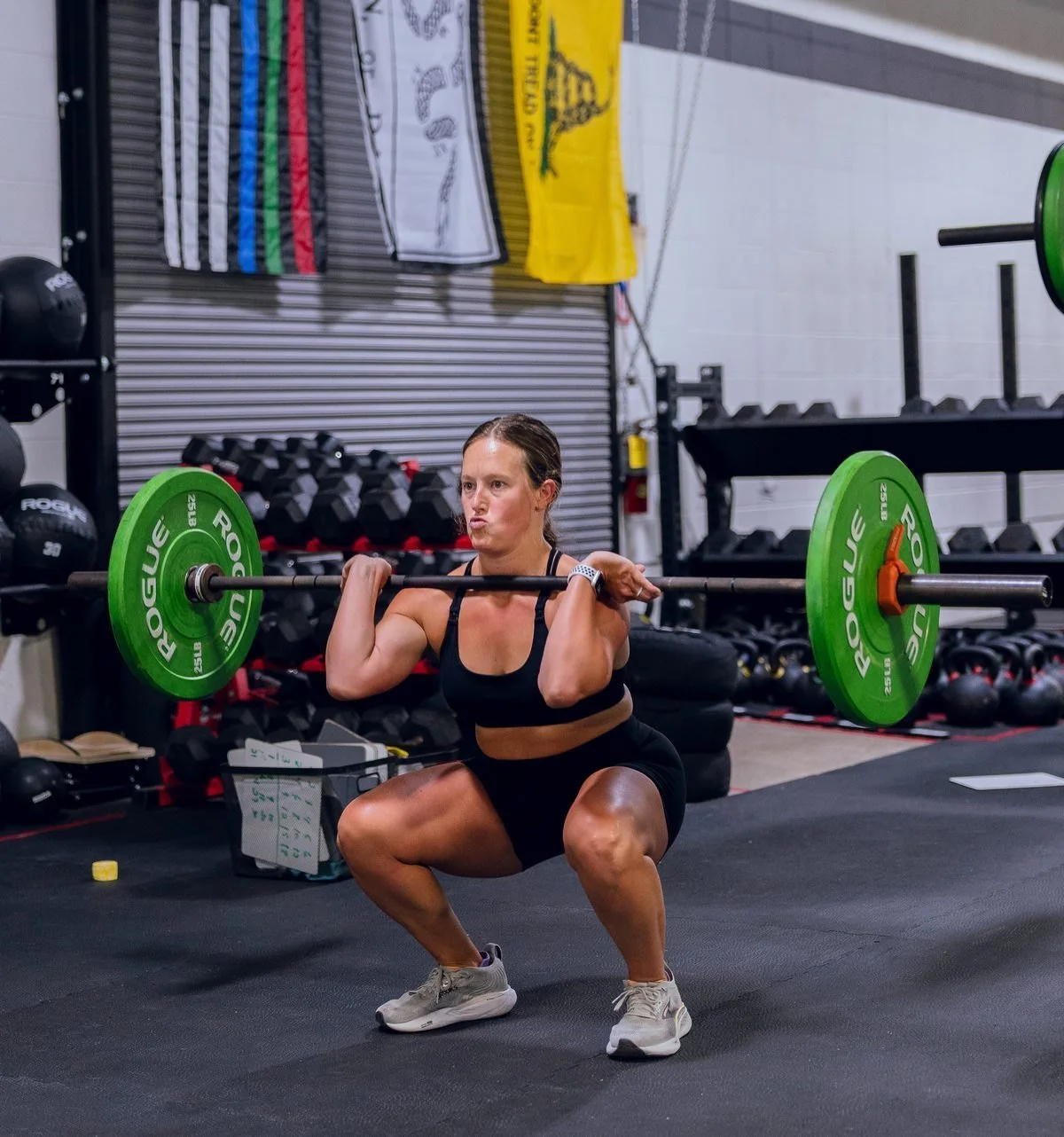
Every few years the internet rediscovers the same “hot take”: "High-rep Olympic lifts are dangerous and unnecessary for normal people." Put a barbell in Grandma's hands, make her do 30 snatches for time, and she'll be in a surgeon's waiting room by Tuesday - they say.
You see the Olympic lifts and their variations in our WODs at Coefficient a lot, and especially with our clean & jerk strength cycle about to start and the amazing work that Coaches Rylee and Grace will offer in our dedicated Oly classes, I want to tackle the internet-hater objections thoroughly.
Seth Page from Jump Ship Training recently did an episode of The Steelman on the Sevan Podcast called "High Rep Olympic Lifts are Dangerous and Unnecessary" [1]. He spends the first part of the show arguing the critics' side as hard as he can before he takes the mask off. He borrowed a lot of it from Mark Rippetoe's 2013 piece "The Fallacy of High Rep Olympic Weightlifting." Here's the honest version:
What the internet trolls say
- Most of us aren't Games athletes. Walk into an affiliate and you'll see parents, desk workers, and people in their 50s and 60s. They're not technically sound lifters.
- Fatigue wrecks technique. In Seth's words, as your heart rate "goes to the roof and your shoulders and legs become fatigued, the technique just breaks down further." On top of the fatigue, the fact that weightlifting is performed with a rigid steel barbell adds an element of risk that is significantly higher than other types of movements where you can more easily “escape” the consequences of broken technique.
- There are other ways to get fit. Bike sprints, kettlebell swings, dumbbells and sandbags can all get your heart rate up and build strength.
So let’s be honest, the core of these points is true [gasp!] - most of us aren’t Games athletes, technique does break down under fatigue, heavy weights on a barbell carry inherent risk, and you can attain fitness in a variety of different ways. But here’s where those arguments fall short:
1. Scaling & modification applies to ALL movement. CrossFit was built to be scaled. Take the workout “Isabel” for example - 30 reps of snatches for time, prescribed weights of 135#/95#. The same workout can be done with a PVC pipe, a training bar, dumbbells, the prescribed 135/95 pounds, or anything in between.
When you see the prescribed workout and think "80 year old Grandma can't do Isabel", that absolutely does NOT mean "Grandma should not do snatches". The fix is to give her the right load, the right reps, and the right instruction from a coach. As Greg Glassman famously said, "The needs of an Olympic athlete and our grandparents differ by degree, not kind."
And the barbell isn't the hazard it's made out to be: injury-rate studies put CrossFit and Olympic weightlifting at roughly 2–3 injuries per 1,000 training hours, comparable to other non-contact sports [2][3][4]. Nobody should simply avoid movements, especially those with benefits as profound as the Olympic lifts (see point #3 below) - rather, the coaches at Coefficient are going to help you safely and methodically develop the required technique, strength, and practice to embrace movements. Everyone can, and should, pursue beneficial movements, no matter how complex and no matter where they are starting from.
2. Safe training and athletic movement is about the pursuit of perfect movement, not the requirement of perfection. For most movements, especially the Olympic lifts, it’s essentially impossible to actually achieve a “perfect” lift. There is always something that can be at least slightly improved, even for the best lifters in the world and the pursuit of the perfect lift is something we should all strive for.
With that said, there are much more clear lines that separate technique that is safe or NOT. This is the priority for your coaches and the reason that proper scaling and modification is essential. Once your technique improves to a level where you can safely add weight, add reps, add speed, etc. there will always be more things to work on to improve and make the technique even better. The fact that there exists a gap between safe and perfect, does not mean the “non-elite” who live deep in that range cannot and should not continue to train the movements.
What’s more, in CrossFit we will practice these movements in a variety of applications, including high rep workouts under duress. This is critical - practicing a technical movement while your heart rate is high, at a load you can control, is exactly what makes you fitter. It isn't a design flaw.
3. Olympic lifts are uniquely essential to comprehensive fitness. Of course, there are lots of seemingly “fit” people who do not perform Olympic lifts, but in CrossFit we define fitness as the ability to demonstrate work capacity across all types of modalities and in conjunction with the development of the 10 general physical skills. The Olympic lifts are unique compared to just about any other movement in their dependency on all 10 of the general physical skills, the need to apply power, and their functional nature as a core-to-extremity movement.
- Power. They teach you to apply force fast, which is the heart of CrossFit's definition of fitness: more work across broad time and modal domains. The clean and snatch are among the most powerful movements in sport, and the CF-L1 Training Guide notes they train athletes to activate more muscle fibers more rapidly than any other modality of training.
- The neurological skills. Coordination, agility, balance, and accuracy are skills you gain through practice, and the lifts demand all four along with strength, speed, and flexibility. CrossFit lists all 10 general physical skills; you can't fake the timing on a snatch.
- Core to extremity. They train the midline-first pattern behind CrossFit’s "core to extremity" principle: hip extension, then a powerful shrug and pull, then fast elbows. That carries over to jumping, throwing, and nearly every other sport.
- Functional movement. Picking something off the ground and putting it on your shoulders or overhead fast is a real-life movement. It's also what Glassman meant when he said you don't need elite technique to benefit [5].
At Coefficient we’re going to ask you to embrace all different types of movement, and in the pursuit of truly comprehensive fitness that can be objectively defined and measured, the Olympic lifts simply cannot be avoided. Our coaches will help you develop the technique, consistency, and then (and only then) how to safely apply intensity to your snatch and clean & jerk. Keep showing up, keep working through these lifts, and the results for your fitness and health will speak for themselves.
— Coach Pat
References
- Seth Page (Jump Ship Training), "High Rep Olympic Lifts are Dangerous and Unnecessary | The Steelman – Ep. 3," The Sevan Podcast, Sept 28, 2026. https://exa.ai/library/podcast/jcbbt05jfy8/episode/sq8v65njc3t
- Hak PT, Hodzovic E, Hickey B. "The nature and prevalence of injury during CrossFit training." J Strength Cond Res, 2013. https://doi.org/10.1519/JSC.0000000000000318
- Klimek C, et al. "Are Injuries More Common With CrossFit Training Than Other Forms of Exercise?" J Sport Rehabil, 2018. https://doi.org/10.1123/jsr.2016-0040
- Aasa U, et al. "Injuries among weightlifters and powerlifters: a systematic review." Br J Sports Med, 2017. https://doi.org/10.1136/bjsports-2016-096037
- Glassman G. "The Clean." CrossFit Journal, 2003 (passage read aloud in [1]). https://journal.crossfit.com/article/the-clean
Find your constant at Coefficient.
Start with Fundamentals, a free trial class, or a free Saturday.